Folio IV · The founder
One engineer.
Full responsibility.
 Founder & AI Engineer
Why a studio called Byte Zentrix
I made the name up years before the studio existed, and it's built from three pieces. A byte is the smallest unit of information: the place every answer starts. Zen is calm and clarity. And the -trix comes from matrix, the grid where everything connects.
Put together, that's the whole studio. Documents are the noisiest place in any company: hundreds of PDFs, three versions of the same policy, nobody sure which one is right. The hard part of AI over that mess isn't making it answer. It's making the answer checkable: which document, which page, which line, and an honest “I don't know” when there's no source. Calm, connected order, byte by byte, back to the source.
Why founder-led
Consulting firms typically add a 2–3× markup on the engineer doing the work. With Byte Zentrix you skip that layer: you talk to the person designing and writing your system, and that person is accountable for whether it works.
I'm a BS Software Engineering graduate from Sir Syed University (SSUET), with a background in the MERN stack, Next.js, FastAPI and production DevOps. Certifications include Cisco's Modern AI Architect (Python & Agentics) and AWS Essentials of Prompt Engineering.
Folio IV.b · Before the studio
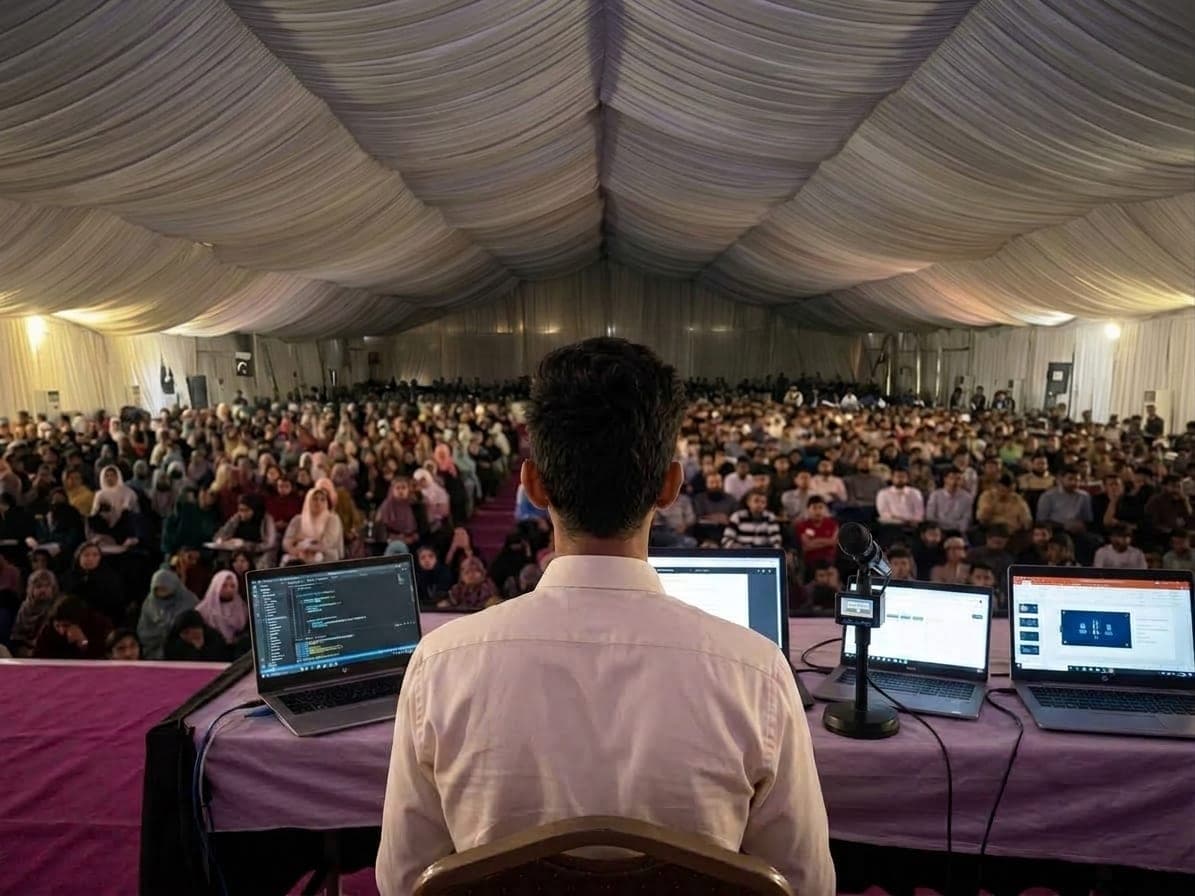
I sat in that hall as a student first.
Two and a half years at the Governor House IT Initiative in Karachi: first on the floor learning, then at the front as a teaching assistant, helping hundreds of students through AI agents, agentic loops and TypeScript.

The quarter where attention fell off
Most of the room was new to the field. Things went well until TypeScript started in the second quarter, and then you could feel the class slipping: more screens closed, fewer questions, the usual signs that people had stopped following and were too shy to say so.
So we changed the format instead of repeating the lecture louder. With the teachers, including Sir Zia and Sir Ameen, we ran quizzes, small competitions and hands-on activities in class. The point wasn't the score. It was that every student could see, in ten minutes, exactly which topic had not landed for them, and then practise that one thing before exams instead of guessing.
The energy came back. Students who had gone quiet started arguing about answers, and the questions after class got sharper. I spent a lot of those months sitting with people one on one, unpicking whatever had blocked them. I learned as much from explaining it as I did from studying it, and I came out of that period with a lot of duas from people I had only meant to help with a compiler error.
- 01
Explaining beats knowing
If a room of beginners can't follow the explanation, the explanation is wrong, not the room. Clients get the same respect.
- 02
Find the weak topic early
Quizzes surfaced exactly which concept had not landed. Evaluation sets do the same job for an AI system before handoff.
- 03
Energy is a design problem
Attention drops for a reason. Change the format, not the audience.
The chain so far
- 2.5 yrs
Governor House IT Initiative, Karachi. Joined as a student, finished as a teaching assistant for AI agents, agentic loops and TypeScript.
- 2025
Full-stack developer at Iotfiy Solutions, Karachi. Built a React/Redux dashboard for 500+ daily users with RBAC.
- 2025
Built the Robotics AI Tutor and cut its response time from 4.2s to 1.2s. That's where the obsession with retrieval started.
- 2026
Full-stack developer (remote) for Ababeel, a Dubai-based team. Next.js, APIs, auth in production.
- 2026
Delivered a study-material assistant with citations for a client in 3 days. Founded Byte Zentrix.
Principles
- Principle i
No invented numbers
In practiceIf a metric is on this site, it was measured. If there isn't one, you'll read what happened instead.
- Principle ii
Refusing beats guessing
In practiceAn assistant that says “not in your documents” is more useful than one that is confidently wrong.
- Principle iii
Plain English
In practiceTrade-offs explained so a non-engineer can make the call, including when an idea would hurt accuracy.
- Principle iv
Small, honest studio
In practiceOne founder today. Specialists added when a project needs them, named and introduced before they start.